Camac Blog
Flavours of Turkish Music for Harpists: An Open-Source Primer by Şirin Pancaroğlu
Latest
March 3, 2026
Harpist Şirin Pancaroğlu’s work with the Turkish Harp Project is recognised worldwide, including performing on authentic instruments, leading workshops globally, and publishing and composing highly acclaimed original music influenced by Turkish musical idioms.
With her latest educational resource, “Flavours of Turkish Music for Harpists,” Şirin draws on her extensive experience exploring Turkish harp music to inspire harpists from any background and introduce them to Turkish melodies and rhythms in a clear, accessible manner. This collection of carefully collected and notated melodies adopts an approach that respects both the harp’s natural qualities and Turkish musical traditions. Designed for lever harp (though suitable for pedal harp), the 120 studies are thoughtfully graded for pedagogical purposes.
Origins and Reconnection: Şirin’s Journey Back to Her Roots
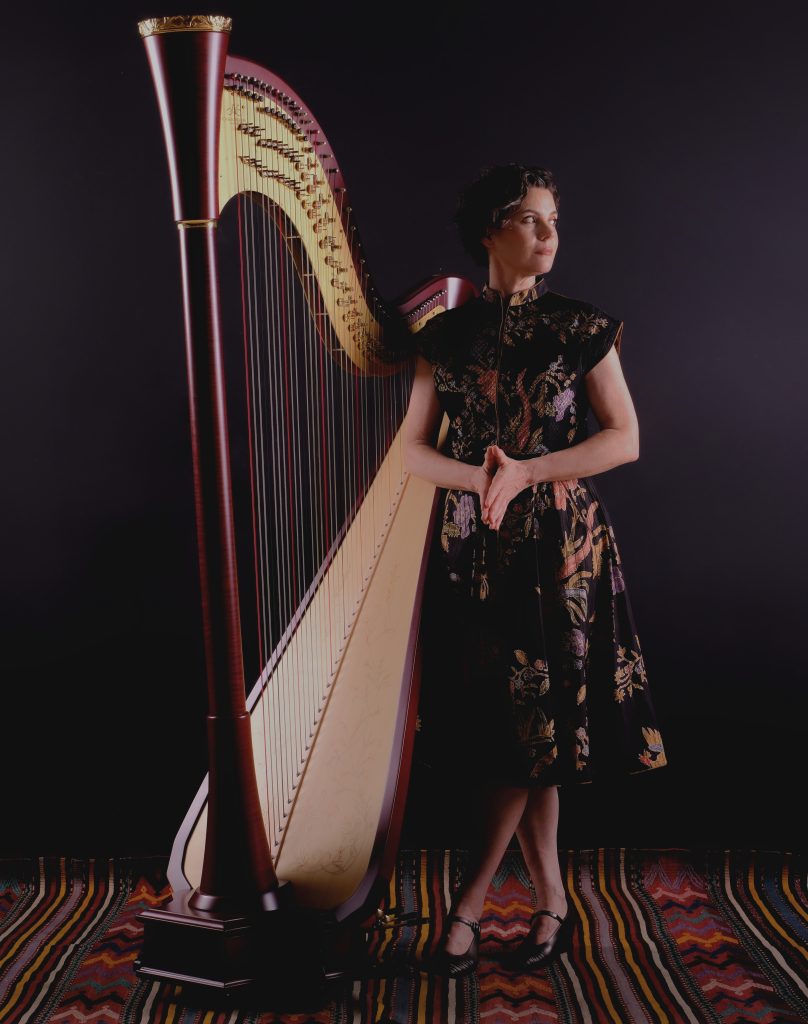
Having left Turkey while still in her teens and studied in Geneva and later in Bloomington (with the late Susann MacDonald), Şirin was in her early thirties when she returned to her homeland to settle. With comprehensive training in Western harp literature, Şirin had not programmed any pieces that could be considered Turkish music. If the opportunity arose to perform traditional music, she had to arrange it herself, as there was little published or easily accessible for a harpist, since few had followed that path before. After nearly 20 years abroad, Şirin decided it was time to reconnect with her roots. Returning to her homeland and seeking new directions for the harp, she saw this as an opportunity to integrate the Turkish aspects of her identity, both personally and musically.
Working closely with contemporary Turkish composers was her first step in this process, and being immersed in a totally new vocabulary was very invigorating: “I immediately thought this is interesting, because the framework was a contemporary piece in a Western approach. However, looking at the basic elements,I thought, well, those rhythms, I’m not sure any Westerner can play those […] it really comes from our own traditional music; changing, complex, uneven meters”
This resulted in a deepening engagement with not only Turkish traditional music but also with the forgotten historical harp of her native land.
Reviving the Ancient Çeng: Bridging Traditions and Modern Practice
Having grown up in a family rich in Turkish history and culture, Şirin had long been fascinated by the images her sister, an art historian specialising in medieval Islamic art, shared with her. These included miniature paintings and illuminated scripts, often featuring scenes in which a harp-like instrument, the çeng, plays a central role. The çeng is an ancient instrument from Mesopotamia, dating back 4,000–5,000 years. Its design varies, and it has travelled through Syria, Iran, Iraq, China, Japan, and Korea, forming a family of related instruments with cultural significance in Persian and Ottoman regions. As a Turkish harp player, Şirin felt it was vital to understand and revive the çeng. Her work involves collaborating with instrument makers to build playable prototypes, as no historical instrument survived.
As a Turkish musician with Western training, Şirin faced challenges when engaging with traditional Turkish music. “Reaching Turkish masters was straightforward; they appreciated my genuine interest in their often forgotten instrument. […] Turkish musicians master their instruments through oral tradition, memorising hundreds of melodies and techniques, making the musical practice highly practical and improvisational. Success requires humility and a deep understanding of this tradition, which can be tough for outsiders to grasp.”
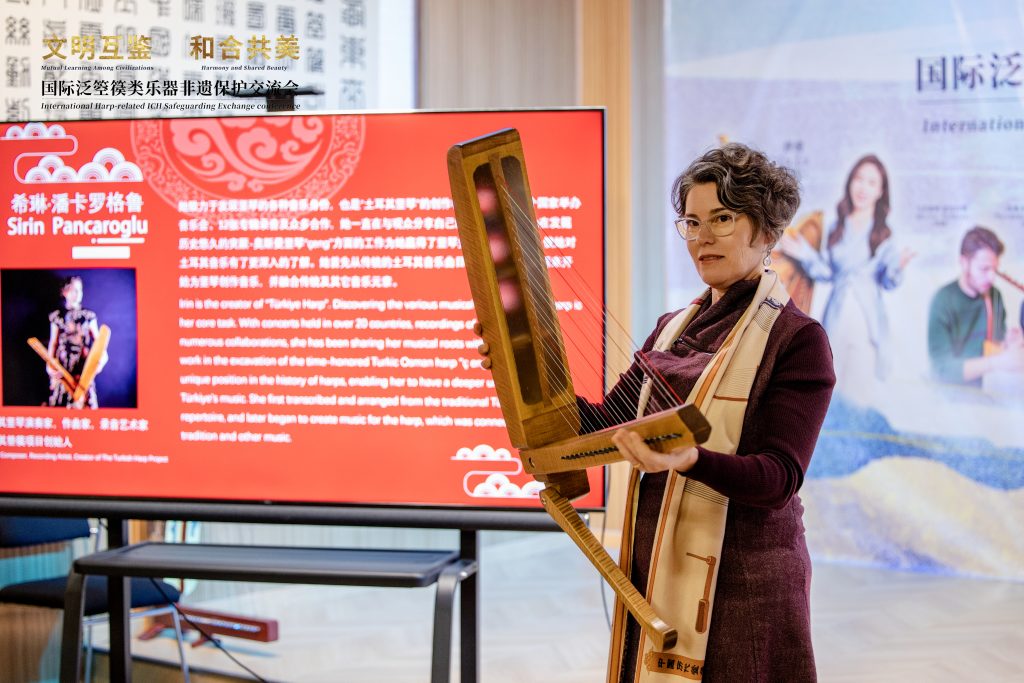
Sirin_Pancaroğlu presents the çeng at a recent lecture.
On top of this, Şirin had to reckon with the fact that the çeng functions quite differently from the Western harp, i.e., that its vocabulary is much more melodic than harmonic accompaniments. Turkish music is melodic and notated on a single staff. “Stringed instrument players add melodic embellishments and focus on a horizontal flow coupled with rigorous rhythm,”
How the Resource works
Having gathered knowledge and experience, raising awareness of this ancient harp within the harp community felt to Şirin like a valuable next step, and the most effective way to achieve this seemed to be to present and notate this musical language for players of the Western lever or pedal harp. But how would her Western colleagues approach this highly melodic music?
The melodies specifically composed for this resource serve as a primer for the material in The Turkish Harp Music Collection, the critically annotated edition of Turkish music for modern harps, comprising 26 works published by 80 Days Publishing. By accessing this resource, players can acquire knowledge to help them engage with more advanced pieces of the music collection.
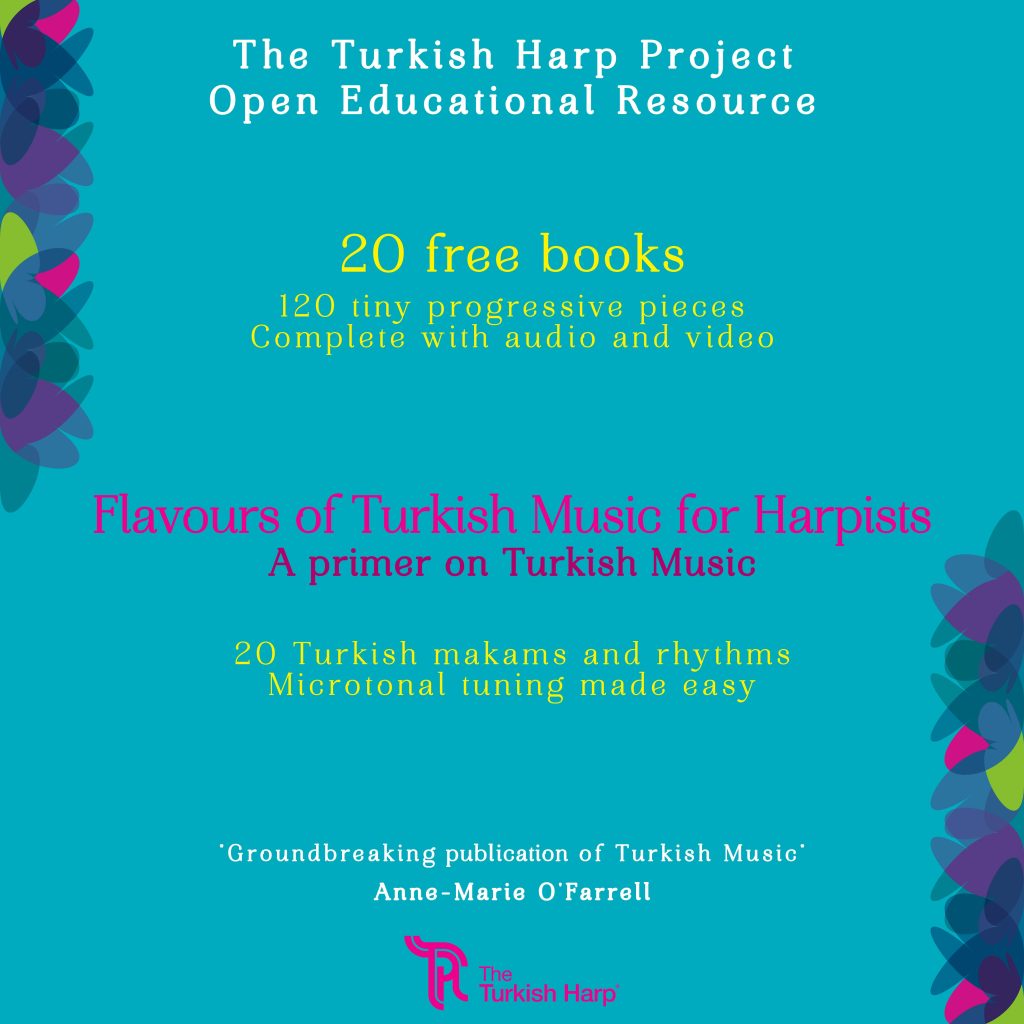
“The pieces inside [in Flavours of Turkish Music] are very short. They’re more like little studies or études, actually” The études are categorised by their makam. Makam is the Turkish system for creating melodies, shaped by colourful scales and inherent motivic characteristics. The author carefully developed and categorised the material to help harpists understand these elements of Turkish music, and although this process has spanned nearly a decade, Şirin decided it should be an open resource, free for all at the point of use.
“This should be accessible to everyone […] Writing this primer was a huge learning process for me, and I felt I should share it with the harp community. Technology now makes sharing easy and joyful. It’s wonderful to be able to simply download and offer these resources, which is liberating. Sharing fosters connection, much as oral traditions do in transmitting music, though our modern methods are evolving. Through technology, such as the Turkish Harp Sessions, which are the audio companion of the music collection, we preserve these cultural practices in new ways.”
A rapidly expanding cross-cultural venture
In all, as well as the Turkish Harp Music Collection, the primer is a testament to Şirin’s profound study of Turkish harp music: “If you said 10 years ago, someday you’re going to be composing music, arranging, transcribing, publishing, I would have laughed.”
“Flavours of Turkish Music for Harpists” is just one branch of a vast transcultural initiative, “The Turkish Harp Project”, and its activities are going from strength to strength. Şirin believes that this deep immersion can broaden all of our horizons: “That’s what Turkish music allowed me to do; it’s a very practical music that if you play, you think, you perform. It’s a sort of sound and rhythmic vocabulary […] that allows your brain to begin functioning in a slightly different way. It has been a very gratifying process.”
The twenty volumes of Flavours of Turkish Music for Harpists are available for free download on the 80 Days Publishing website – an open invitation to broaden our musical horizons and explore, on the harp, the richness of a thousand-year-old language.
https://80dayspublishing.com/collections/lever-harp-downloads/flavours-of-turkish-music
Related posts
Camac’s 50th anniversary festival…in Paris!
August 31, 2022
Fifty years of passion for the harp, half a century at the heart of the harp community - it’s our anniversary year! Join our celebrations in Paris, October 21-23. Read more…
“A key to invisible locks”: Mandragore comes to the Espace Camac
November 16, 2024
We are delighted to invite you to the ‘Cordes de soie’ concert by the travelling harpist Mandragore. Mandragore takes us on a fabulous journey from Bosnia to Central Asia to share her adventures, her passion for Balkan and Oriental music, and her passion for the harp. Ahead of her appearance at the Espace Camac, we asked Mandragore about her background, her painstaking research and some real life adventures! Read more…